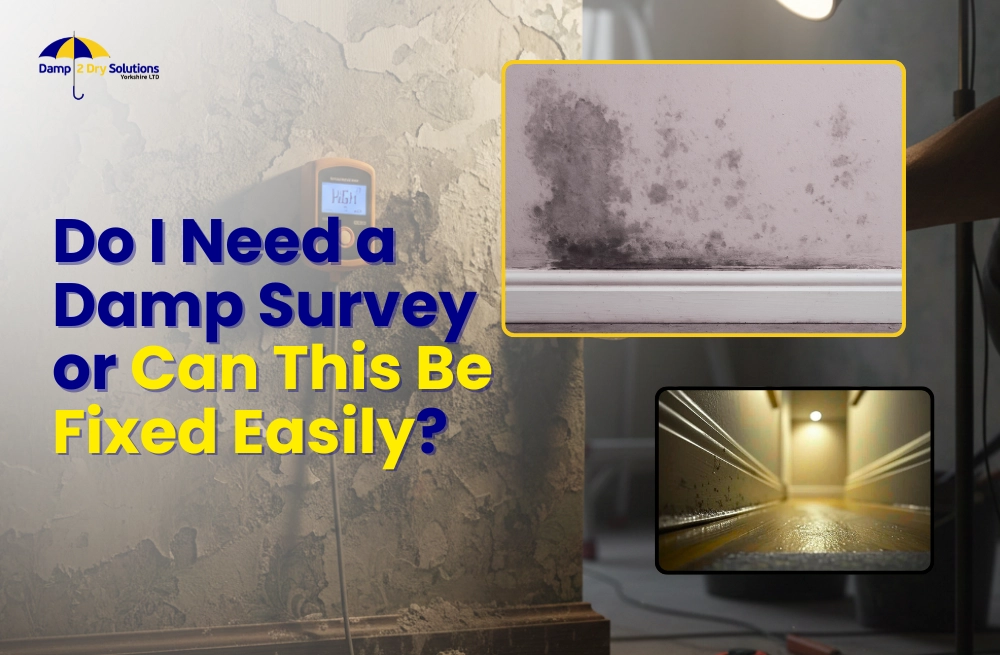
If you’ve noticed damp patches, peeling paint, or a musty smell in your home, it’s normal to stop and wonder:
Do I really need a damp survey, or is this something I can sort myself?
You’re not overthinking it. Across West Yorkshire, many homeowners delay taking action. Not because they don’t care, but because they worry about unnecessary work, high costs, or being pushed into treatments they don’t actually need.
This guide is here to give you clear, honest answers. No scare stories. No technical jargon. Just practical advice to help you decide when a damp survey makes sense and when it probably doesn’t.
What Is a Damp Survey (And What It Isn’t)?
A damp survey is a proper check of your home to find out why moisture is appearing, not just where you can see it.
What it actually involves
- Looking at internal walls, floors, and timbers
- Checking outside areas like brickwork, gutters, ground levels, and ventilation
- Using moisture meters alongside visual checks
- Working out whether the damp is active, old, or caused by condensation
What it is NOT
- A sales visit pretending to be an inspection
- An automatic recommendation for damp proofing
- A one-size-fits-all solution
A good damp survey should help you avoid unnecessary work, not create more of it.
Why Homeowners in West Yorkshire Hesitate
Let’s be honest. Most hesitation comes down to a few common worries:
- “I don’t want to uncover a massive problem.”
- “What if it’s something minor and I’m making a fuss?”
- “I’ve heard damp proofing can be expensive.”
These concerns are understandable. West Yorkshire has many older stone and brick homes, and not every damp issue means major work. In fact, the wrong treatment can sometimes cause more problems than the damp itself.
That’s why getting the diagnosis right matters.
When Damp Issues Can Be Fixed Easily
Not every damp problem means structural work or a full survey. A lot of damp issues we see in Leeds, Bradford, Huddersfield, and Wakefield come down to everyday maintenance or ventilation, rather than faults in the building.
The key is knowing whether the issue is environmental (how the home is used or maintained) or structural (a problem with the building itself). When it’s environmental, the fix is often simple and affordable.
Common Low-Risk Damp Issues
These problems can look worrying at first, but are often straightforward once identified.
Condensation from poor ventilation
Condensation, this is very common, especially in winter. Moisture from showers, cooking, and drying clothes builds up inside the home. If it can’t escape, it settles on cold walls and windows. Improving airflow, using extractor fans properly, or adding ventilation often clears the issue without further work.
Blocked or leaking gutters
Gutters full of leaves or debris can overflow when it rains. Water then runs down the outside walls and shows up indoors as damp patches. Clearing or repairing the gutters usually allows the wall to dry out naturally.
Faulty or leaking downpipes
A loose joint or crack in a downpipe can release water right at the base of a wall. Over time, this soaks the brickwork and causes internal damp. Fixing the pipe is often all that’s needed.
Ground levels too high against external walls
In older homes, paths, driveways, or flower beds are sometimes built too high. When they sit above the damp proof course, moisture can bypass it. Lowering the ground or improving drainage can solve the problem without touching the inside of the house.
Everyday living habits
Drying washing indoors, keeping windows shut all year, or not using bathroom and kitchen fans increases humidity. This doesn’t mean there’s a fault with the building. Small changes can make a big difference within a few weeks.
Signs It May Not Need a Full Damp Survey
Every home is different, but these signs often point to a manageable issue rather than a serious damp problem.
The damp mainly appears in winter
If it improves in warmer months, condensation is often the cause. Cold walls and warm indoor air create ideal conditions for moisture.
Mould improves with better ventilation
If opening windows, using fans, or running a dehumidifier helps, it’s a strong sign the issue is airflow-related.
Only one room is affected
Structural damp usually affects more than one area. A single room often points to a local issue.
No tide marks, powdery salts, or crumbling plaster
These are typical signs of rising or penetrating damp. If they’re not present, long-term structural damp is less likely.
In situations like this, simple advice, basic maintenance, or small improvements are often enough. Knowing when not to escalate is just as important as knowing when to act.
When a Damp Survey Is the Sensible Option
Some signs shouldn’t be ignored. Putting these off often leads to bigger repairs and higher costs later.
You should seriously consider a damp survey if:
- Damp keeps coming back after previous fixes
- You see tide marks or white salt deposits on walls
- Plaster is cracking, blowing, or feels hollow
- Skirting boards are soft, rotting, or damaged
- More than one room is affected
- You’re buying or selling a property
- There are signs of timber decay or woodworm
At this point, guessing usually costs more than checking properly.
Rising Damp, Penetrating Damp, or Condensation? Why Guessing Doesn’t Work
Many homeowners try to diagnose damp based on online searches. The problem is that different types of damp can look very similar.
Why symptoms overlap
- Condensation can look like rising damp
- Penetrating damp can appear like an internal leak
- Old plaster can stay damp long after the cause is fixed
The Royal Institution of Chartered Surveyors (RICS) notes that misdiagnosis is one of the main reasons damp problems keep returning after treatment.
Put simply, treating the wrong issue wastes money.
Does a Damp Survey Lock You Into Work?
This is a common worry, but the answer is no.
A proper damp survey gives you:
- A clear understanding of what’s going on
- The confidence to say no to work you don’t need
- Written evidence for buyers, sellers, or solicitors
Think of it like a health check. You wouldn’t start treatment without knowing what’s actually wrong.
Why Yorkshire Homes Need a Local Approach
Homes in West Yorkshire have their own challenges:
- Higher rainfall
- Older solid-wall construction
- Damp proof courses that are outdated or missing
- Insulation upgrades that affect airflow
What works for a modern house elsewhere doesn’t always apply here. Local knowledge makes a real difference.
Buying or Selling a Home? A Damp Survey Becomes Important
If there’s visible damp, surveyors will flag it. Buyers get nervous. Mortgage lenders may hold things up.
A damp survey can:
- Prevent price drops later
- Stop sales falling through
- Provide clear written evidence
- Allow problems to be fixed properly, not rushed
For buyers, it avoids taking on hidden issues.
Can a Damp Survey Save You Money?
Often, yes.
A survey can help:
- Avoid unnecessary damp proofing
- Stop repeated redecorating
- Catch external defects early
- Prevent timber damage spreading unseen
In one Yorkshire home, a survey saved thousands by showing the real problem was a single faulty downpipe, not internal damp.
How to Spot If You’re Being Oversold
A reliable damp specialist will:
- Explain things clearly, without jargon
- Show you evidence
- Separate urgent issues from minor ones
- Offer options, not pressure
If someone jumps straight to treatments without checking properly, that’s a warning sign.
So, Do You Need a Damp Survey or Not?
Here’s the honest answer.
If the issue is new, minor, and clearly linked to ventilation or maintenance, you may not need one yet.
If the problem keeps coming back, isn’t clear, affects the structure, or involves buying or selling, a damp survey is usually the safest and most cost-effective step.
Ignoring it rarely works out cheaper.
A Final Thought for Hesitant Homeowners
You don’t book a damp survey because you want bad news. You do it because you want clarity.
Clarity means:
- No guessing
- No unnecessary spending
- No repeating the same problem
And in a Yorkshire home, that peace of mind is worth far more than covering up damp and hoping it doesn’t return.
If you’re unsure what to do next, start by understanding the problem properly. Everything else becomes easier from there. If you’re not sure what’s causing damp in your home, Damp2Dry Solutions (Yorkshire) Ltd offers clear, no-pressure free damp surveys across West Yorkshire, focused on finding the cause, not selling treatments.